Index guide
Kludoku
Kludoku is a daily murder-mystery logic puzzle where testimony constrains each suspect to one row and column until a single person could be alone with the victim.
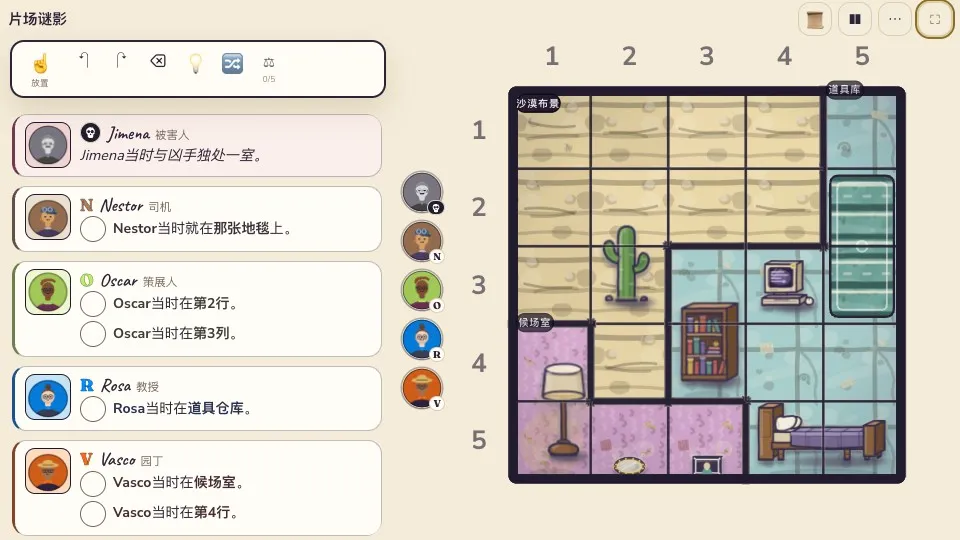
Continue playing on the publisher's official site.
Player reviews
What did players make of it?
Loading player ratings…
Loading reviews…
Verified round model
How a round of Kludoku works.
Objective, input, feedback and stopping condition checked 8 September 2026.
Objective
Place every suspect consistently with the testimony and identify the only person who could have been alone with the victim.
Your move
Select a suspect and a grid square, mark exclusions, inspect testimony highlights, or branch into a temporary What if hypothesis.
What changes
The board tracks placed suspects, highlights testimony-relevant squares, removes occupied rows and columns from consideration, and exposes undo, redo, erase, and hint controls.
Round end
Once all suspects are placed, the accusation step opens; harder cases may also require identifying a lying accomplice or proving a motive.
Why it stands out
Place everyone before naming the murderer.
Kludoku ties each sentence to specific squares. A clue removes cells from one suspect; the row, column, and room rules then remove cells from others. The final accusation depends on the completed placement and the victim's room.
Best for
- Logic-grid solvers who want narrative clues tied to a visible floor plan.
- Players who value several daily difficulty levels and fully archived cases.
Think twice if
- Players looking for a thirty-second puzzle with little reading.
- Solvers who dislike cases where advanced modes introduce a systematic liar or motive layer.
Translate testimony into candidate cells
Start by marking where each suspect can still be. Different clues create different shapes on the board:
- a room statement selects every cell inside that room;
- a row or column statement selects one line;
- a furniture clue selects the cells occupied by that object;
- a neighbor clue selects the cells beside another person or object.
Intersect clues about the same suspect. A row crossing a room may leave one square, which is far more useful than either clue on its own.
Update every candidate set after a placement
After placing a suspect, remove that row and column from every other candidate set. Check the room boundaries again too. These updates will often eliminate several more cells.
Return to broad testimony after each placement. A room clue that began with six possible cells may now have only one.
Accuse late
Complete a consistent scene before using the victim to identify the murderer. With only a few suspects left, compare their possible rooms with the victim’s room and keep the pairing that satisfies every testimony. In accomplice cases, invert the liar’s complete set of statements as one rule.
Use What if for a two-cell tie
What if is most useful when a suspect has two remaining cells. Try one cell and apply every row, column, and room consequence. A contradiction rejects that branch. A branch without a contradiction still needs support from the other suspects.
How to play
- Read every suspect’s testimony and translate statements about rooms, rows, columns, furniture, and neighbors into allowed or excluded squares.
- Place each suspect exactly once so no two people share a row or column; use notes, undo, and What if branches when needed.
- After every person has a consistent position, accuse the suspect who was alone in the same room as the victim.
Game passport
A quick read before you play.
Play
- Mechanics
- Logic grid, Spatial deduction, Murder mystery
- Input
- Pointer or touch suspect placement, exclusion marks, and testimony controls
- Language load
- High
Access
- Price
- Free to play
- Account
- Not required
- Mobile friendly
- Yes
Return
- Cadence
- Daily
- Archive
- Available
- Features
- Stats: Yes
Index status
- Editorial depth
- Guide
- Difficulty
- Demanding
Related games
Keep the same kind of attention.
good next step
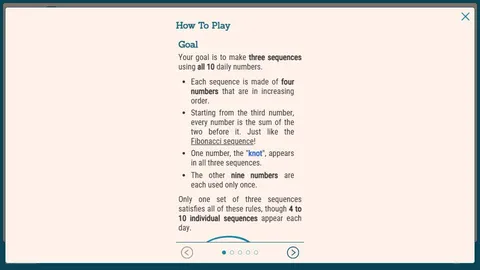
Knotilus
Knotilus stays in Word & Logic, using numbers and logic as the way in.
same mechanic
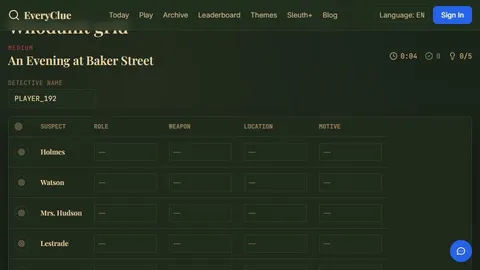
EveryClue
EveryClue also ends in a daily accusation, but uses a conventional attribute grid rather than placing people inside a mapped crime scene.
lower language load
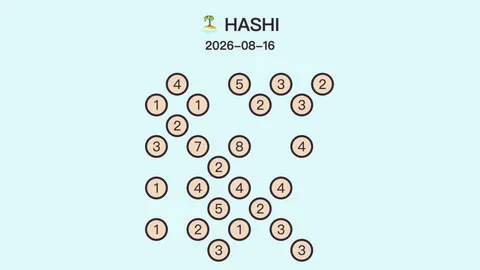
Daily Hashi
Daily Hashi keeps exact row-and-column spatial reasoning while replacing testimony with numbered islands and non-crossing bridges.
same mechanic
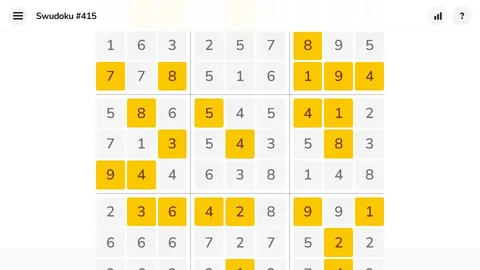
Swudoku
Swudoku also centers on spatial deduction, but approaches the solve through tile swapping.
good next step
Chemicle
Chemicle is another Word & Logic pick, built around numbers and logic.

Before you play
Questions before you play.
- How many Kludoku cases are published each day?
- The official site currently offers ten shared cases: five difficulty levels in untimed play and five corresponding time-attack cases.
- Does Kludoku require an account?
- No. The daily cases open in guest mode and save progress in the current browser; registration is offered for synchronization and social features.
- What makes an expert Kludoku case harder?
- Larger boards may add an accomplice whose statements are all false, and some cases require a motive as well as the murderer.
- Can you play old Kludoku cases?
- Yes. The case calendar preserves finished daily boards and written walkthroughs.
Source ledger
The evidence behind this page.
The official anonymous daily route, live 5×5 case, localized controls, archive, explanatory pages, and creator release page establish the product identity, rules, daily schedule, access model, creator credit, and advanced-case boundaries.
- Kludoku official daily gameOfficial, Web, checked 8 September 2026
- What is Kludoku?Official, Web, checked 8 September 2026
- Kludoku itch.io release and development logCreator profile, Creator, checked 8 September 2026