Index guide
MOW
MOW is a daily route-planning puzzle from a lawn-care nonprofit: cover every grass square in one continuous path while visiting numbered waypoints in order.
The official game is loaded above. If it does not respond, open the publisher’s site in a new tab.
Player reviews
What did players make of it?
Loading player ratings…
Loading reviews…
Verified round model
How a round of MOW works.
Objective, input, feedback and stopping condition checked 10 August 2026.
Objective
Mow every playable grass square in one continuous route while visiting each numbered waypoint in ascending order.
Your move
Drag the mower from one adjacent grass square to the next, extending a single route through the yard without lifting it.
What changes
The board preserves the mowed route, shows the mower’s current position and numbered waypoints, and displays elapsed time and coverage progress.
Round end
The daily yard is complete when the continuous route has covered every grass square and passed all numbered waypoints in order.
Why it stands out
Every safe-looking step must preserve a route through the whole yard.
MOW is easiest to understand as a constrained coverage route, not a maze. Reaching the next waypoint is only a temporary goal: the path must also leave every remaining grass region reachable without revisiting a square. The lawn theme makes the state readable, while ordered checkpoints divide one large Hamiltonian-style problem into smaller planning intervals.
Best for
- Visual logic players who prefer route planning with almost no vocabulary requirement.
- Short-session solvers who enjoy improving a clean path across a shared daily board.
Think twice if
- Players looking for action controls, random rewards, or a competitive multiplayer round.
- Solvers who dislike restarting after a locally valid move isolates an unvisited pocket.
Coverage matters more than reaching the next number
The mower has to pass the numbered waypoints in ascending order, but touching the next number does not make the route good. Every playable grass square must also be covered without lifting the mower. A move can therefore satisfy the immediate checkpoint and still fail by sealing off an unvisited pocket.
Read the gray or non-grass cells as the boundary of the route problem. Narrow channels, corners, and the spaces around numbered waypoints deserve attention before the first drag because they have fewer possible entrances and exits than open lawn.
Checkpoints divide the yard into route intervals
Instead of planning one enormous line from start to finish, work between two consecutive numbers. Ask which grass must be consumed before reaching the next waypoint and which squares must remain available as an exit toward the following one. This reduces the board to a sequence of smaller coverage decisions.
Do not automatically enter a numbered square as soon as it is reachable. If it sits at the mouth of a region, crossing it early may cut off the only route back through that region. The safer move is the one that preserves the required degree of every unvisited square: interior path squares normally need both an entrance and an exit.
The timer records pace, not a deadline
The current board displays elapsed time and progress, while the official copy describes a calm daily puzzle rather than a countdown challenge. Solve for a complete route first. Once the board structure is familiar, the same planning method can reduce hesitation and improve time without replacing deduction with random swipes.
The daily yard is shared across web and app. The official site also lists streak tracking, result sharing, and a past-yard archive. Those features establish ways to return; they do not establish the size of the player audience.
A practical route-planning method
- Identify corners, single-width corridors, and grass pockets with only one plausible entrance.
- Trace the waypoint order and note which constrained regions lie between each consecutive pair.
- Delay a checkpoint when entering it would close the only exit from nearby unvisited grass.
- Avoid leaving a single isolated square behind the mower unless it is the final destination of the whole route.
- When a route fails, restart from the first move that created a disconnected region instead of changing random later steps.
Trail is the closest mechanical comparison: it also asks for one all-cells path through ordered numbers. MOW distinguishes the surrounding product with its lawn presentation, web-and-app parity, archives, and connection to the verified lawn-care nonprofit. WordPath is a more layered alternative because its drawn route becomes a constraint for a subsequent word guess.
How to play
- Start on the yard grid and drag the mower through adjacent grass squares.
- Visit every numbered waypoint in ascending order while keeping one continuous path.
- Clear every grass square to finish the shared daily yard.
Game passport
A quick read before you play.
Play
- Mechanics
- Path planning, Grid coverage, Ordered waypoints
- Input
- Drag the mower across adjacent grass squares
- Language load
- Low
Access
- Price
- Free to play
- Account
- Not required
Return
- Cadence
- Daily
- Archive
- Available
- Features
- Stats: Yes · Sharing: Yes
Index status
- Editorial depth
- Guide
- Play time
- About 2 minutes
- Difficulty
- Moderate
Around the web
A positive iOS signal with limited reach
The visible App Store review awards five stars and values both the daily thinking challenge and the game’s community-minded nonprofit purpose.
What drew players back
- The reviewer says the daily puzzle makes them think rather than treating it as a passive cause-marketing extra.
- They also value the connection to community and nonprofit work.
What got in the way
- The visible review does not discuss controls, restarts, route failures, or difficulty, so it provides no evidence about the puzzle’s main friction points.
One readable review and the listing’s three-rating aggregate were checked on the US App Store; this is too small a sample for a general quality claim. This evidence applies to the iOS listing, not necessarily the browser build; one readable review and three total ratings cannot establish representative sentiment.
Related games
Keep the same kind of attention.

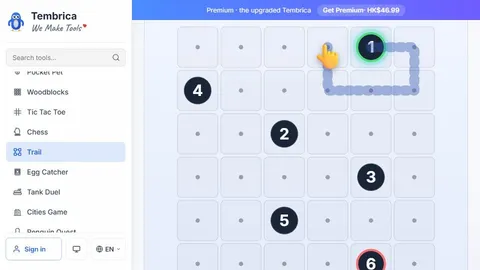
same mechanic
Trail
Trail uses the same continuous all-cells path and ordered-checkpoint core, but presents it as an abstract Hamiltonian grid with practice and weekly modes.
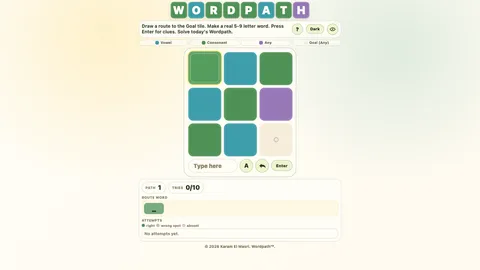
more strategic
WordPath
WordPath also asks players to draw an ordered route, then adds a second phase where that route constrains a five- to nine-letter word guess.
good next step
Meowdoku.online
Meowdoku.online is another Word & Logic pick, built around spatial logic.

good next step
Patches Game Online
Patches Game Online is another Word & Logic pick, built around spatial logic.

Before you play
Questions before you play.
- What is the goal of the MOW daily puzzle?
- Cover every playable grass square with one continuous mower route while visiting all numbered waypoints in ascending order.
- Does MOW require a volunteer account?
- No. The puzzle opens without an account; sign-in belongs to the nonprofit’s separate volunteer coordination tools.
- Is MOW timed?
- The board displays elapsed time, but the official description presents the puzzle as a calm route challenge rather than a countdown deadline.
- Can previous MOW yards be replayed?
- Yes. The official play page lists past-yard archives alongside the current daily board, streak tracking, and result sharing.
Source ledger
The evidence behind this page.
The nonprofit’s official play page and volunteer FAQ establish the game identity, grid-coverage rule, ordered waypoints, daily schedule, browser access, estimated duration, streak, sharing, and archive behavior.
- MOW daily puzzleOfficial, Web, checked 10 August 2026
- I Want To Mow Your Lawn volunteer FAQOfficial, Web, checked 10 August 2026
- MOW: A Daily Puzzle on the US App StoreStore listing, iOS, checked 10 August 2026