One-sentence premise
The central action and objective can be stated directly without a tutorial or several conditional systems.
Daily games, critically selected.
Help players discover approachable daily formats with a specific identity, without claiming an unverified completion time.
Six daily games with a compact premise strong enough to create a recognizable decision without adding layers of unnecessary instruction.
Small rules are most useful when they expose a distinctive thought. These games can be introduced clearly, but the joke, visual transformation, ranking structure, or prediction problem gives each one a reason to exist beyond familiarity.
Independently selected · Reviewed July 28, 2026
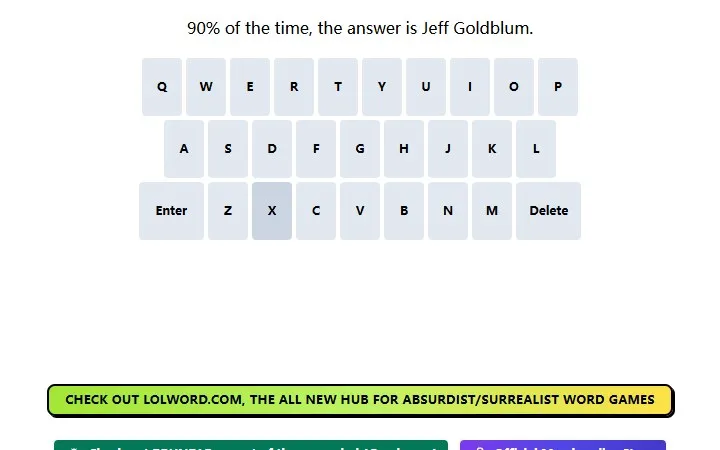 Start with JeffgoldblumleThree guesses and one recurring twelve-letter joke establish the premise immediately, while the exception keeps recognition from becoming automatic.
Quick answer
Start with JeffGoldblumle for the quickest premise, choose ColorGuesser for a direct visual judgment, or pick Factle when you want a compact rule with a stronger reasoning loop.
Three guesses and one recurring twelve-letter answer make the daily joke immediately legible.
Best visual ideaColorGuesserTranslate a familiar color name into one precise point, then inspect the measured miss.
Best reasoning loopFactleOrder five supplied answers and use positional feedback to repair the ranking.
The definition
A compact explanation should remove setup, not remove the decision. The strongest games here reach a recognizable interaction quickly and provide a payoff that is more specific than a familiar shell.
The central action and objective can be stated directly without a tutorial or several conditional systems.
The player still has to perceive, predict, rank, route or decode rather than merely trigger a novelty.
The feedback or reveal makes the idea recognizable enough to justify another daily attempt.
Choose a route
These games stay approachable through short rules, but they ask for different kinds of judgment after the premise has been understood.
Recognize one twelve-letter answer while accounting for the small exception built into the daily format.
I want a word routePoopleChange one letter per move and plan an efficient path toward the fixed destination.
I want a visual judgmentColorGuesserPlace one named color on a wheel and compare your mental swatch with the target.
I want to rank factsFactleArrange five supplied answers, read the feedback and revise their order.
I want to predict a crowdScrandleChoose between two food images before the public preference is revealed.
I want to decode a symbolGlyphSeparate overlapping letter strokes hidden inside one compact mark.
The curated set
Each selection can be introduced in one clear sentence, then earns its place through a decision or reveal that is recognizably its own.
Start here
Three guesses and one recurring twelve-letter joke establish the premise immediately, while the exception keeps recognition from becoming automatic.
Letter route
Change one letter at a time until the ladder reaches a fixed silly destination; the rule is compact, but efficient routes still differ.

Visual precision
A color name and a wheel are enough to expose how uncertain familiar labels become when they must be translated into a precise choice.
Rank and repair
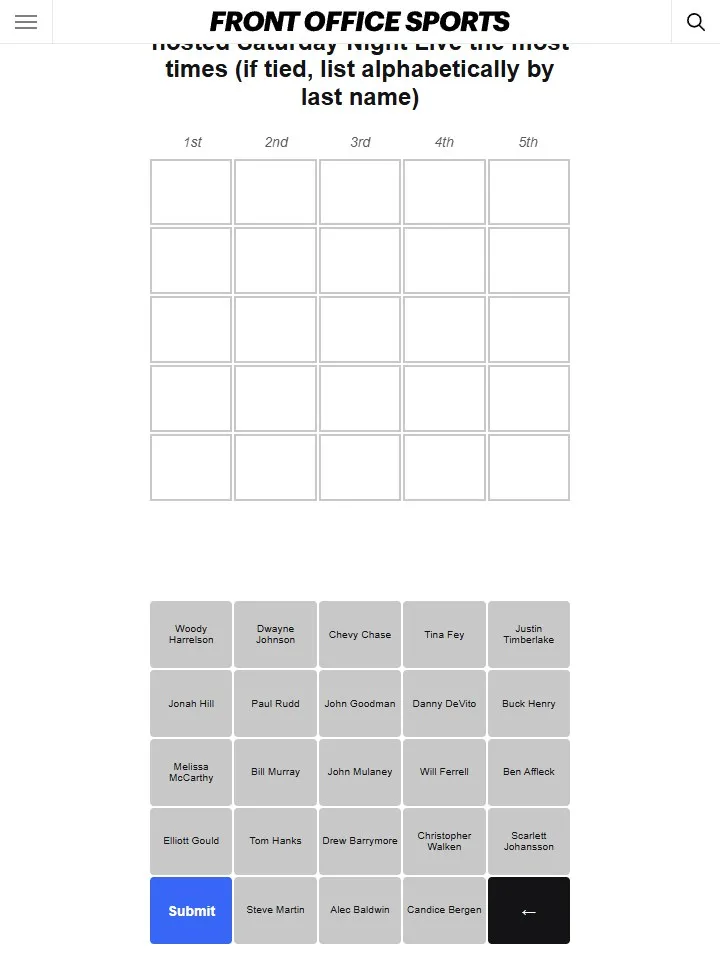
Rank five answers, read the positional feedback, and repair the order; a familiar feedback loop is redirected toward factual comparison.
Crowd prediction
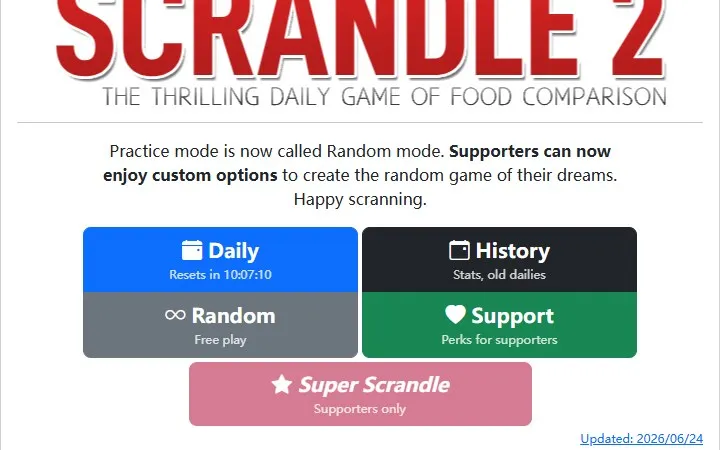
Choose which of two food photos received the stronger public verdict, turning a simple binary decision into a study of shared taste.

Layered letters
One layered mark contains the word, making visual decomposition the whole premise without surrounding it with a larger ruleset.
At a glance
The rules stay short, but the input, feedback and distinctive turn show why the games do not collapse into the same interaction.
| Game | Core rule | Main input | Feedback | Distinctive turn |
|---|---|---|---|---|
| Jeffgoldblumle | Identify one recurring name | Keyboard guess | Three-guess result | A small daily exception |
| Poople | Change one letter per move | Keyboard word | Valid ladder step | Route efficiency |
| ColorGuesser | Match a named color | Color-wheel point | Target distance and score | Mental color precision |
| Factle | Order five answers | Arrange supplied items | Position feedback | Factual ranking |
| Scrandle | Pick the favored photo | Binary image choice | Public verdict | Shared taste prediction |
| Glyph | Read layered letters | Keyboard word | Guess result | Visual decomposition |
How to choose
It reaches the premise fastest and makes the repeated format part of the humor rather than disguising it.
It replaces recall with one precise visual placement and makes the size of the miss visible.
The five answers are supplied, leaving the player to compare them and repair the order through feedback.
The rule is only one letter per move, but each valid intermediate word changes the efficiency of the path.
Editorial boundary
Simplicity alone is not enough. A game belongs here only when its short explanation opens into a specific and repeatable decision.
A standard hidden-word board does not qualify merely because it has a different theme or answer list.
Games that require several systems or a lengthy tutorial fall outside a collection centered on immediately legible rules.
A funny premise still needs a meaningful prediction, ranking, route, perception or decoding choice.
Selection method
Questions, answered
JeffGoldblumle has the fastest premise because the repeated twelve-letter joke and three-guess format can be introduced directly.
Poople emphasizes route efficiency, while Factle builds a stronger feedback-and-revision loop around factual ranking.
ColorGuesser asks players to place a named color on a wheel, and Scrandle presents one direct choice between two images.
No. The set includes color perception, factual ranking and crowd prediction alongside word routing and letter decoding.
Not necessarily. This collection verifies the compactness of the premise, not a universal completion time for every player or device.