Index guide
Kinship
Kinship is a daily semantic word puzzle that gives four clue words and asks for the single word connected to all four, with every guess receiving a rank.
The official game is loaded above. If it does not respond, open the publisher’s site in a new tab.
Player reviews
What did players make of it?
Loading player ratings…
Loading reviews…
Verified round model
How a round of Kinship works.
Objective, input, feedback and stopping condition checked 17 August 2026.
Objective
Find the single daily answer that has a meaningful relationship with all four clue words at the same time.
Your move
Type a candidate into the answer field and submit it with Guess; the page also offers Give Up when the puzzle should be ended.
What changes
Every submitted word receives a semantic rank, where rank 1 is the answer and smaller numbers indicate closer usage relationships.
Round end
The round resolves when a submitted word reaches rank 1 or the player chooses Give Up; the clue set changes each day at midnight Pacific time.
Why it stands out
Four semantic directions make one good rank insufficient.
Kinship’s ranking system is useful but deliberately imperfect: a candidate can rank well because it sits near one clue while ignoring the other three. The real decision problem is therefore balancing four relationships rather than following the numerically closest guess without explanation.
Best for
- Players who enjoy open-ended word association with numerical feedback after every guess.
- Solvers willing to compare several clue relationships instead of following one obvious synonym chain.
Think twice if
- Players who want exact letter-position feedback or a tightly bounded dictionary-style clue.
Look for an intersection, not four separate synonyms
The four clues do not each hide a different answer. One word must make sense beside all four. Start by writing a relationship for each clue—compound phrase, category, role, property, or common context—then look for a candidate appearing in several lists.
A very strong pairwise connection is not enough. MONSTER, for example, can
sit close to BEAST and therefore receive a useful rank while saying almost
nothing about the other three clues. The official instructions identify this
as a deliberate limitation of the feedback.
Treat rank as direction, not proof
Every guess gets a rank based on how words are used in English. Smaller is closer and rank 1 is the answer, but the number does not explain which clue caused the proximity. After a strong rank, test the word explicitly against each clue before exploring its synonyms and neighbors.
If a candidate explains only one clue, keep the vocabulary area but change the relationship. If it fits three clues, investigate the weakest fourth link; that is often more productive than replacing the whole idea.
A practical four-clue method
- Assign at least one relationship type to every clue.
- Submit a broad word that plausibly touches two or more clues.
- Use the rank to choose a semantic neighborhood, not a final answer.
- Reject candidates that cannot produce a concrete phrase or association for all four clues.
- Narrow within the surviving neighborhood until one word balances all four links.
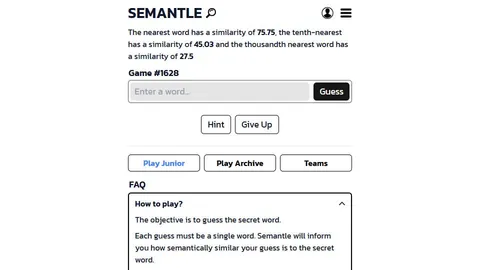
Semantle is the closest rank-feedback comparison, but removes the four visible anchors. Connections moves in the other direction: it supplies more words and asks for several discrete groups instead of one semantic center.
How to play
- Read all four clue words and list relationships that could apply to more than one clue.
- Type one candidate word and submit it to receive a semantic rank.
- Use lower ranks as closer feedback while checking that the candidate still connects all four clues.
Game passport
A quick read before you play.
Play
- Mechanics
- Semantic association, Ranked feedback, Four-clue intersection
- Input
- Keyboard entry for a candidate word
- Language load
- High
Access
- Price
- Free to play
- Account
- Not required
Return
- Cadence
- Daily
Index status
- Editorial depth
- Guide
- Difficulty
- Moderate
Related games
Keep the same kind of attention.
same mechanic
Semantle
Semantle also returns semantic proximity ranks, but asks players to approach one hidden word without Kinship’s four visible anchor clues.

more strategic
Connections
Connections also tests relationships among words, but partitions sixteen terms into groups instead of locating one word shared by four anchors.
good next step
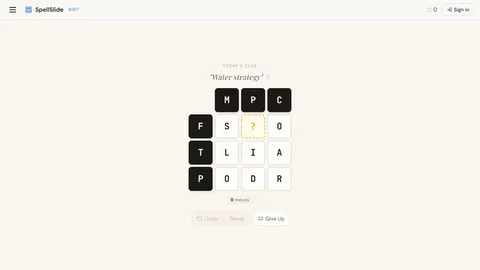
SpellSlide
SpellSlide is another Word & Logic pick, built around sliding tiles.
good next step
Squarrel Daily
Squarrel Daily is another Brief Games pick, built around rotating minigame.
Before you play
Questions before you play.
- What is the goal in Kinship?
- Find the one daily word that connects meaningfully to all four clue words displayed around the board.
- What does a Kinship rank mean?
- Rank 1 is the answer, and a smaller number means the guess tends to occur in more similar English contexts.
- Can a high-ranking Kinship guess still be misleading?
- Yes. The official instructions warn that a word may rank well because it is very close to just one clue while fitting the other three poorly.
- When does the Kinship puzzle change?
- The creator announcement states that the puzzle changes every day at midnight Pacific time.
Source ledger
The evidence behind this page.
The live puzzle and first-person announcement establish Kinship’s official route, four-clue objective, ranked semantic feedback, daily cadence, anonymous browser access, and midnight-Pacific reset.
- Kinship official game and How it works dialogOfficial, Web, checked 17 August 2026
- Kinship creator announcement in the r/puzzles promotion threadCreator profile, Creator, checked 17 August 2026