Index guide
Shople
Guess a mystery brand in ten tries by comparing headquarters, age, size, ownership, industry, revenue and shopping-channel clues.
Continue playing on the publisher's official site.
Player reviews
What did players make of it?
Loading player ratings…
Loading reviews…
Verified round model
How a round of Shople works.
Objective, input, feedback and stopping condition checked 30 September 2026.
Objective
Identify the daily mystery brand within ten guesses.
Your move
Type a brand and select it from the autocomplete list.
What changes
Each guess returns eight company-fact tiles marked exact, close or not close; numeric comparisons can also point higher or lower.
Round end
The round ends when the mystery brand is identified or all ten guesses are spent.
Why it stands out
Use the numeric arrows to narrow the field before chasing exact categories.
Shople turns brand recognition into a data-comparison puzzle. A near founding year and a higher revenue arrow can be more useful together than a familiar logo, while sector labels force a choice between broad and narrow company categories.
Best for
- Players who know retail, technology and consumer brands but want more than a logo quiz.
- Solvers who like combining categorical matches with numeric higher-or-lower clues.
Think twice if
- Players who do not want company size, revenue or industry terminology in a trivia game.
Eight comparisons from one guess
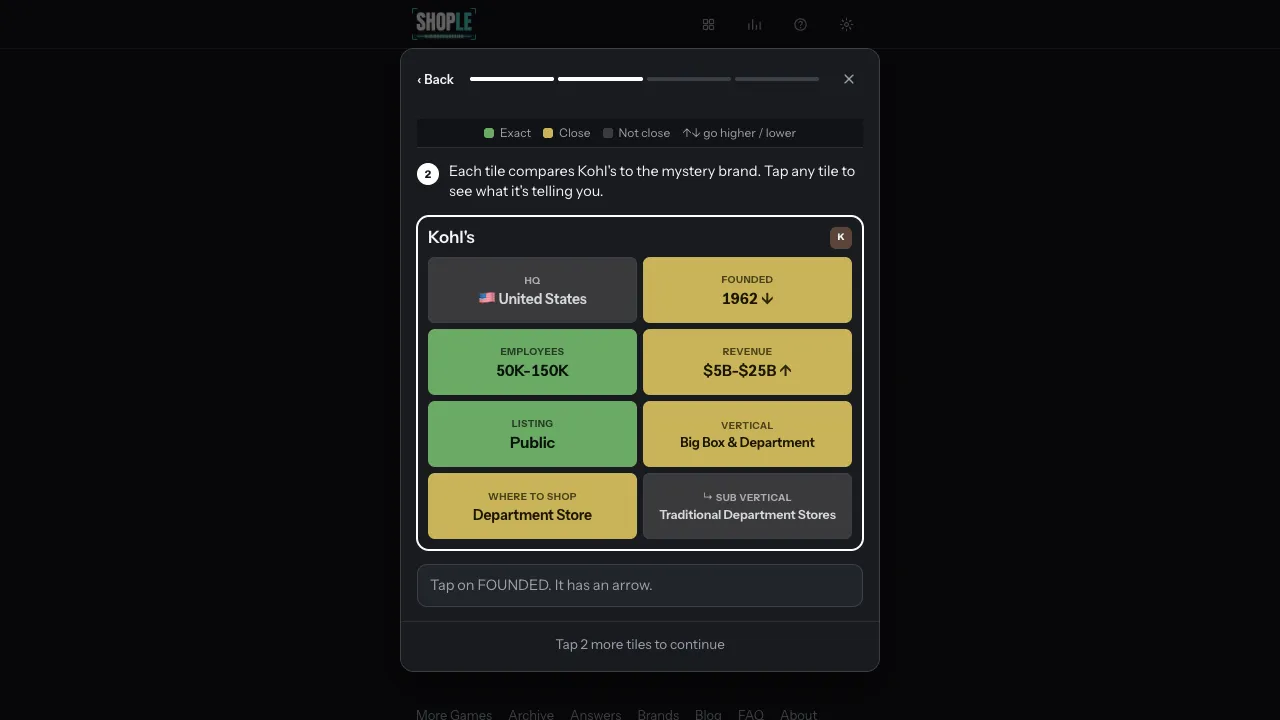
Shople does not reveal a logo. You begin by typing a brand and selecting it from the suggestion list. The submitted brand is then compared with the mystery brand across headquarters country, founding year, employee range, estimated revenue, public or private status, vertical, sub-vertical and where it is sold.
The interactive tutorial uses Kohl’s as an example. Its employee range and listing status are exact matches, while its founding year and revenue are close. Those numeric tiles also point lower or higher. Headquarters and sub-vertical do not match. That combination shows the main task: read the entire row rather than searching for a brand that agrees with one prominent fact.
Use ordered clues before labels
An exact country or ownership status can eliminate many brands, but broad vertical labels may still cover very different businesses. Numeric arrows give a direction for the next guess. If the target was founded earlier and earns more revenue, choose a candidate that tests both boundaries instead of changing only the industry label.
After a directional guess, compare which fields improved. A closer founding year with a worse employee band still narrows two separate ranges. Keep the most stable exact matches and change attributes that remain dark or point strongly away from the current candidate.
About the creator
Shople is published by AdJamVentures LLC. Andrew from the Shople team said in his submission that the team had launched several projects before Shople, but did not name them, so this guide does not make broader claims about the studio’s catalog.
Access and evidence boundary
The checked puzzle offered ten guesses and required no account or payment. The site also exposes an archive and statistics control, but this review did not test archive limits, completed-result sharing or mobile interaction. The stated daily reset is midnight Eastern Time.
For a brand game driven by images, Brandle starts from a blurred logo. Shople instead asks you to use company facts and directional comparisons from typed guesses.
How to play
- Type a brand name and choose it from the suggestion list to submit a guess.
- Compare the eight returned facts with the mystery brand, using exact, close and not-close colors plus higher-or-lower arrows.
- Revise the next guess across headquarters, founding year, employees, revenue, listing status, vertical, sub-vertical and where-to-shop clues.
- Identify the mystery brand before the tenth guess is used.
Game passport
A quick read before you play.
Play
- Mechanics
- Brand deduction, Attribute comparison, Directional feedback
- Input
- Type a brand name, select an autocomplete result, and inspect eight comparison tiles
- Language load
- Medium
Access
- Price
- Free to play
- Account
- Not required
Return
- Cadence
- Daily
- Archive
- Available
- Features
- Stats: Yes
Index status
- Editorial depth
- Guide
Related games
Keep the same kind of attention.

good next step
Sixth Chain
Sixth Chain stays in Trivia & Knowledge, using trivia as the way in.

same mechanic
Anidle
Anidle also centers on attribute comparison, but approaches the solve through attribute comparison.

same mechanic
Spotle
Spotle also centers on attribute comparison, but approaches the solve through attribute comparison.
good next step
FilmSweep
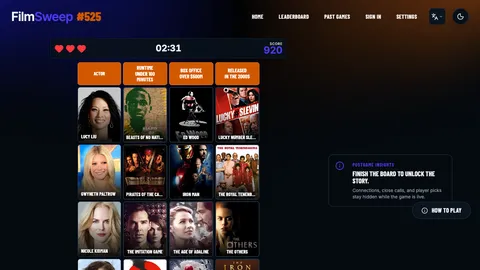
FilmSweep is another Visual & Culture pick, built around movie grid.


good next step
Brainer
Brainer stays in Trivia & Knowledge but shifts the challenge toward mixed-format trivia.
Before you play
Questions before you play.
- How many guesses does Shople allow?
- The daily puzzle provides ten guesses. A brand must be selected from the suggestion list before it is submitted.
- What does each Shople guess reveal?
- It compares eight facts covering headquarters country, founding year, employees, estimated revenue, public or private status, vertical, sub-vertical and where the brand is sold.
- What do the arrows mean?
- For ordered facts such as founding year or revenue, an arrow indicates whether the mystery brand's value is higher or lower than the submitted brand's value.
- Do you need an account to play Shople?
- No account was required to open the daily board and use the interactive tutorial during this check.
Source ledger
The evidence behind this page.
The official site, interactive tutorial and first comparison row were checked anonymously on September 30, 2026. The check established the eight feedback fields and ten-guess loop; the local embedded view stayed blank, so the page uses the official-link fallback. It did not complete the day's target or test mobile play.
- Shople official daily game and interactive tutorialOfficial, Web, checked 30 September 2026
- Shople official rulesOfficial, Web, checked 30 September 2026