Index guide
WordInk
WordInk is a daily word game that gives every player the same two- or three-letter sequence and scores five valid words by how rarely they appear.
The official game is loaded above. If it does not respond, open the publisher’s site in a new tab.
Player reviews
What did players make of it?
Loading player ratings…
Loading reviews…
Verified round model
How a round of WordInk works.
Objective, input, feedback and stopping condition checked 24 August 2026.
Objective
Find the rarest accepted English word that contains the daily two- or three-letter drop as one ordered sequence.
Your move
Type a word into the answer field; it must contain the displayed drop before the Submit button becomes available.
What changes
Each accepted guess receives a rarity value based on observed word frequency, while the page tracks the round total and top score.
Round end
The daily round allows five distinct guesses; the highest rarity value among those attempts is the main result for that puzzle.
Why it stands out
A valid word is only the start; frequency is the real opponent.
WordInk reverses the usual daily-word target. There is no single answer to converge on: the useful choice is whether to spend a limited attempt on an obscure candidate whose frequency score is not obvious from its spelling.
Best for
- Vocabulary tinkerers who enjoy comparing several valid answers instead of finding one fixed target.
- Players who like score optimization and can tolerate a frequency model that sometimes defies intuition.
Think twice if
- Solvers who want letter-position clues leading toward one objectively correct word.
- Players who prefer a dictionary definition or explanation for every accepted answer.
Start with productive word families
The drop is not a bag of letters. It must survive as one sequence inside the
word, so begin with common attachment points rather than free association. For
DED, endings and stems such as “-ded,” “ded-,” or a longer word containing
that run are more useful than listing every word that happens to contain D, E,
and D separately.
Write down several candidates before submitting the first one. WordInk gives only five distinct attempts, and a familiar word is most useful as a baseline when it tells you how the scale behaves. Spending all five guesses on the first ideas that fit the letters wastes the part of the round that involves judgment.
Rarity is not the same as difficulty
The official explanation says the score comes from frequency across books, news, movies, websites, and social media. A technical-looking word can still be common in a specialist corpus, while an ordinary-looking inflection may appear surprisingly seldom. Length, awkward spelling, and rarity often travel together, but none of them guarantees the others.
Use the first accepted score to calibrate the day. Then vary one dimension at a time: move from a common noun to a specialist term, from a base form to a less usual derivative, or from a modern word to an older one. The result is more informative than submitting five unrelated curiosities.
Protect the last two attempts
Keep at least two slots for comparison. Your fourth guess should challenge the best score with a candidate from a different register. The fifth should be the word you believe is rarest after seeing the previous values, not simply the longest word left on the list.
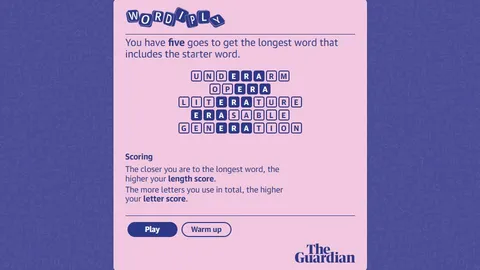
Wordiply is the nearest structural comparison because it also grows a fixed letter sequence into larger words. Its reward is length, which is visible before submission. WordInk hides the important property until after the guess: you know that the word is valid, but not how the frequency model will rate it.
How to play
- Read the two- or three-letter drop shown for today and keep those letters together and in order.
- Enter a valid English word containing the complete drop, then submit it to receive a rarity score.
- Use up to five distinct guesses and try to finish with the rarest accepted word you can find.
Game passport
A quick read before you play.
Play
- Mechanics
- Letter-sequence constraint, Open vocabulary, Rarity scoring
- Input
- Keyboard entry for a word containing the daily letter drop
- Language load
- High
Access
- Price
- Free to play
- Account
- Not required
Return
- Cadence
- Daily
- Archive
- Available
- Features
- Stats: Yes
Index status
- Editorial depth
- Guide
- Difficulty
- Moderate
Related games
Keep the same kind of attention.
good next step
Wordle
Wordle offers the opposite structure: one hidden target with positional feedback instead of many valid answers ranked by corpus frequency.
good next step
Meowdoku.fun
Meowdoku.fun is another Word & Logic pick, built around spatial logic.
good next step
Mathodical
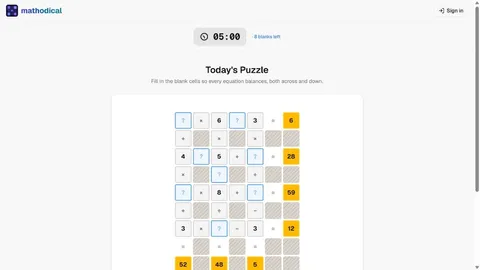
Mathodical is another Word & Logic pick, built around arithmetic.
good next step
Twixtle
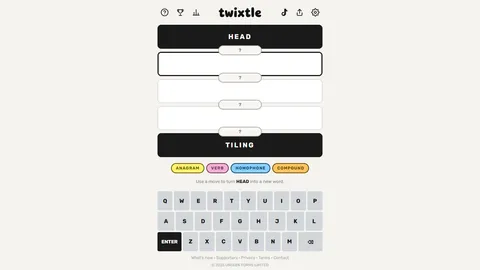
Twixtle is another Word & Logic pick, built around word transformation.
good next step
Packle: Daily Packing
Packle: Daily Packing is another Word & Logic pick, built around spatial packing.
Before you play
Questions before you play.
- What is the goal in WordInk?
- Submit up to five valid words containing the daily letter drop and make your highest rarity score as large as possible.
- Do the daily letters have to stay together?
- Yes. The official example places the full drop inside each word as one sequence, and the live input asks for a word containing that sequence.
- How does WordInk decide whether a word is rare?
- The official instructions say scores reflect frequency across books, news, movies, websites, and social media, with values computed using Zipf’s law.
- Can you play an earlier WordInk puzzle?
- Yes. The live game exposes a Previous puzzle control; the Next control is disabled when the current day is selected.
Source ledger
The evidence behind this page.
The live anonymous puzzle and its official instructions establish the shared daily drop, ordered-sequence input, five-attempt limit, frequency-based feedback, stats, archive control, and current access state.
- WordInk official daily game and How to play dialogOfficial, Web, checked 24 August 2026
- WordInk creator announcement and scoring discussionCreator profile, Creator, checked 24 August 2026