Index guide
Kyōyū
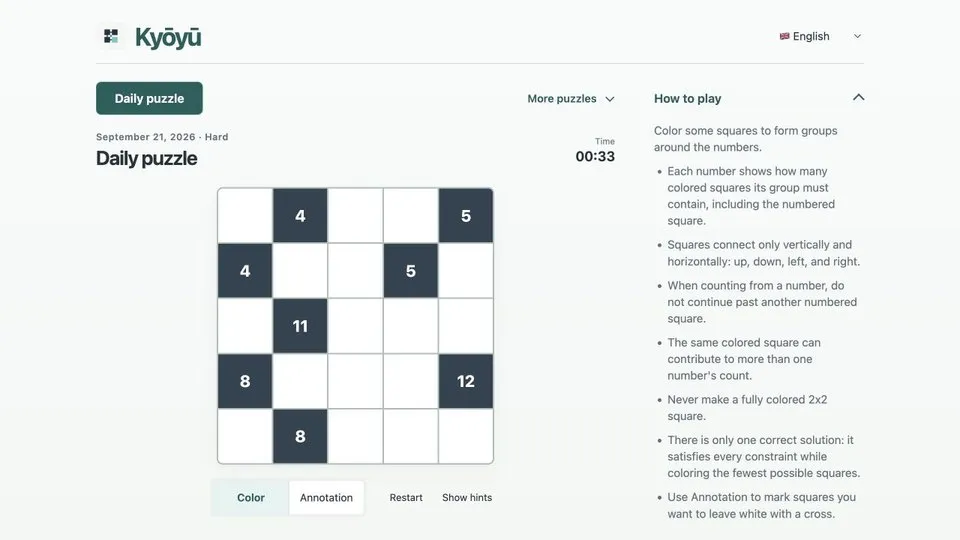
Kyōyū is a daily shading puzzle where several number clues can count the same colored cells, provided every count and the ban on filled 2×2 squares hold.
Continue playing on the publisher's official site.
Player reviews
What did players make of it?
Loading player ratings…
Loading reviews…
Verified round model
How a round of Kyōyū works.
Objective, input, feedback and stopping condition checked 21 September 2026.
Objective
Satisfy every numbered group's size while obeying the no-filled-2×2 rule and using the minimum number of colored cells.
Your move
Click unnumbered squares in Color mode to change shading, or switch to Annotation to cross out squares intended to stay white.
What changes
The board displays numbered clues and a timer; the tutorial describes count inspection and the interface offers a Show hints control.
Round end
The correct solution satisfies all clue counts and the 2×2 restriction with the fewest colored cells; the official rules say this solution is unique.
Why it stands out
Count from every clue separately, including the shared squares.
One shaded cell may count toward multiple clues. You have to recount from each number separately because counting stops at other numbered squares, even within connected shading.
Best for
- Solvers who enjoy small numerical grids with overlapping constraints.
- Players who prefer shading and annotation to entering words or digits.
Think twice if
- Players who want every shaded cell to belong to exactly one numbered region.
A shared cell still needs separate counts
Two nearby clues can use some of the same shaded squares. Count outward from one clue at a time, moving only horizontally or vertically. Include the starting numbered cell. When you reach another numbered square, stop that part of the count there.
That stopping rule is easy to overlook. Treating all connected shading as one group can produce the wrong total for an individual clue.
Before adding another square
Check which clues can reach the square you want to color. It may complete one count while adding too much to another. After a change, recount the affected clues and inspect the surrounding 2×2 blocks.
If three squares of a 2×2 block are already colored, the fourth must stay white. Use Annotation to mark that exclusion. Keep track of which crosses are forced by a rule and which are provisional guesses; you may need to revisit the latter.
The minimum-cell condition matters too. A layout that matches the numbers is still insufficient if it fills a 2×2 block or uses more colored cells than the correct solution. Adding spare shading to repair one count can create trouble elsewhere.
Learning the count rule
The opening tutorial uses small examples before the daily board. Its count inspection explains how shared cells work, and Show hints is available on the main game. The daily board checked on September 21 was a 5×5 Hard puzzle; that observation does not establish a fixed size or difficulty for every day.
Kyōyū is credited to Fabio Rigano in the official footer. The daily puzzle opened without payment or an account, and the interface offers English and Italian. The archive and random puzzles provide more boards; the daily reset timezone remains unconfirmed.
Daily Hashi is another numbered-grid option. Its totals describe bridges touching islands, while Kyōyū requires you to follow the shaded cells reachable from each clue.
How to play
- Read each numbered cell as the required size of its connected colored group, including the numbered square.
- Color cells connected up, down, left, or right. When counting from a clue, stop at another numbered square.
- Allow a colored cell to contribute to several clues, avoid fully colored 2×2 blocks, and satisfy all clues using the fewest colored cells.
Game passport
A quick read before you play.
Play
- Mechanics
- Shared clue counts, Cell shading, Minimum-cell solution
- Input
- Cell selection in Color or Annotation mode, with Restart and Show hints controls
- Language load
- Low
Access
- Price
- Free to play
- Account
- Not required
Return
- Cadence
- Daily
- Archive
- Available
Index status
- Editorial depth
- Guide
Related games
Keep the same kind of attention.

good next step
Kyudoku
Kyudoku stays in Word & Logic, using numbers and logic as the way in.
good next step
Daily Hashi
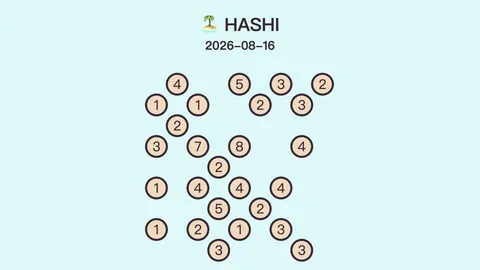
Daily Hashi counts bridges touching numbered islands and requires a connected network; Kyōyū counts shared shaded cells with a 2×2 restriction.

good next step
Wordspool
Wordspool is another Word & Logic pick, built around word association.
good next step
Thinky Dailies
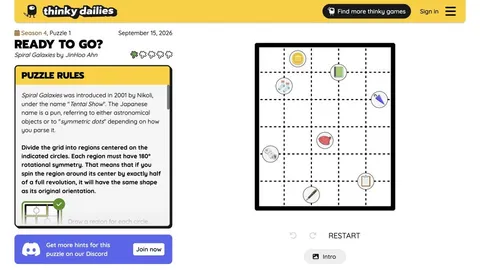
Thinky Dailies is another Word & Logic pick, built around rotating logic puzzles.
good next step
Categories
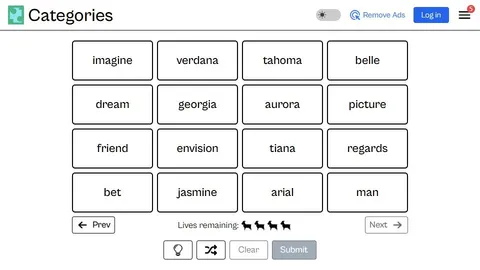
Categories is another Word & Logic pick, built around hidden categories.
Before you play
Questions before you play.
- Can one Kyōyū cell count toward several numbers?
- Yes. A colored square can contribute to more than one clue. Count from each number separately and stop at other numbered squares.
- Is matching all the numbers enough?
- You must also avoid fully colored 2×2 squares and use the fewest colored cells. The official rules describe one correct minimum-cell solution.
- Does Kyōyū have extra puzzles?
- The official interface offers a daily puzzle, an archive, and random puzzles. The daily reset timezone has not been confirmed.
Source ledger
The evidence behind this page.
The official rules and anonymous browser board were checked on September 21, 2026. Unverified creator identity, timing, and access details remain explicitly unknown.
- Kyōyū official game, tutorial, rules, and footerOfficial, Web, checked 21 September 2026